The way we work
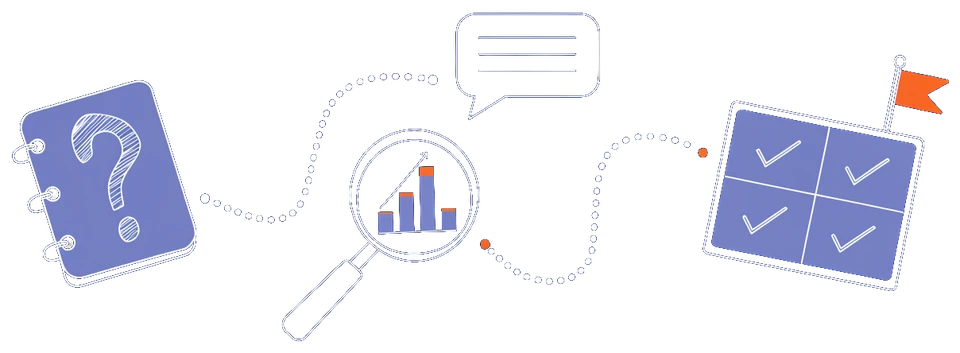
We diagnose before we design.
Most research firms take an order. You arrive knowing you want focus groups, and you get focus groups. Nobody asks whether focus groups answer your question.
We start somewhere else: with the decision you have to make. What are you actually choosing between? What would have to be true for each option to work? What evidence would make you confident? Sometimes the answer is a large study. Often it is a much smaller one than you expected. Occasionally it is that you already know enough, and we will tell you that too.
That diagnosis is done by a senior researcher, before any proposal exists. And the senior researcher who diagnoses your problem is the one who runs your project — start to finish.
The promise
GCR's promise is senior, diagnosis-led consultancy. We start with your marketing problem, not a method, and use our know-how and experience to diagnose what's really at stake. Then we design the right research, right-sized to your budget and timing, and run it end to end, so you make confident decisions at lower risk. The senior researcher who diagnoses your problem is the one who runs your project: a single, expert point of contact across the whole engagement.
Five stages
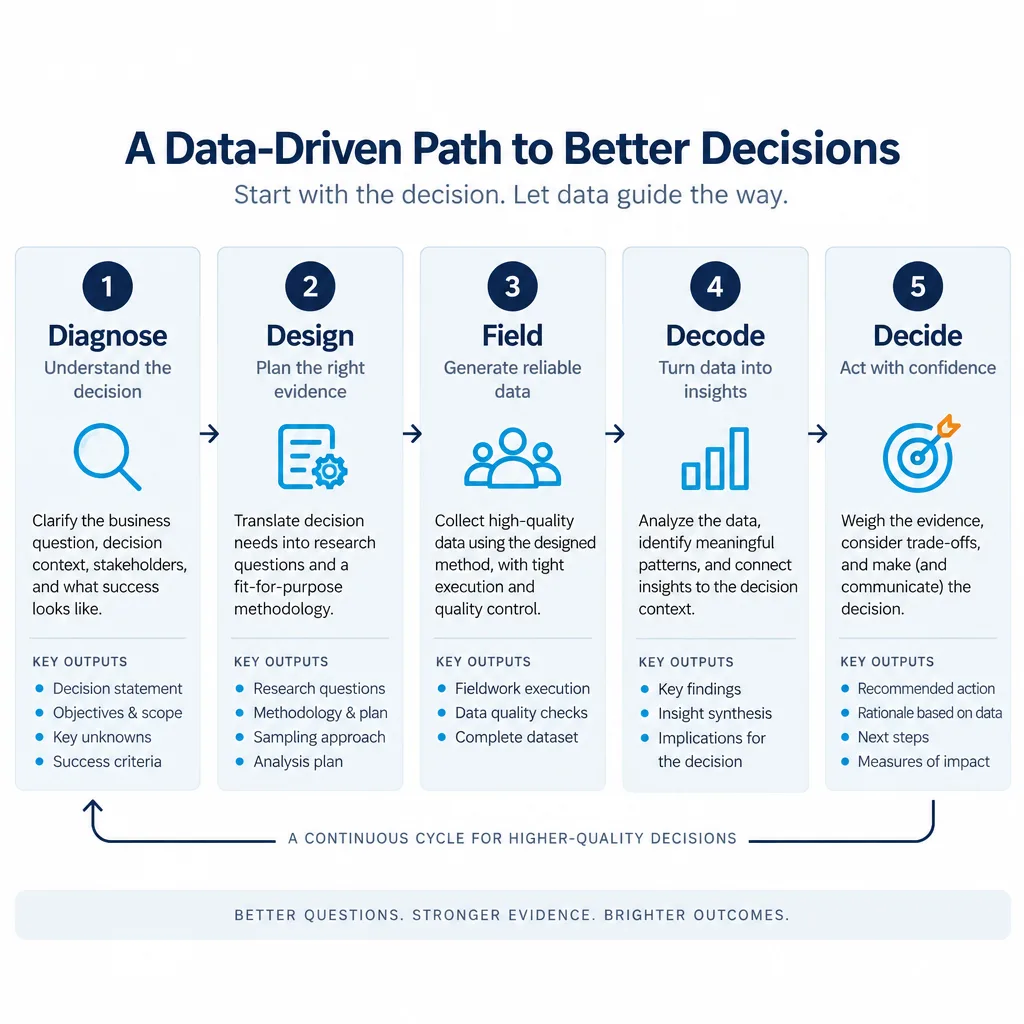
Diagnose → Design → Field → Decode → Decide
Every project runs through the same five stages, whether the work is qualitative, quantitative or mixed. The stage most firms skip is the first one.
- 01
Diagnose
We start with your decision, not a method, and pressure-test what a confident answer really needs.
What happens
A senior researcher works through the decision with you before any proposal exists. What are you choosing between? What would have to be true for each option to work? What evidence would actually change your mind? This is where we establish whether the question you arrived with is the question that needs answering — often it is not, and finding that out early is the cheapest thing we do together.
What you get
A clear statement of the decision, the evidence it requires, and an honest view of whether research is the right next step at all.
- 02
Design
We design the right study — qual, quant, or mixed — right-sized to your budget and timing.
What happens
Only now do we choose instruments. The method follows the decision: exploratory work where the question is why, measurement where the question is how much, and both where the decision genuinely needs them. Sample sizes follow from the sub-groups you need to read, not from a default. Scope is set against your actual budget and timeline rather than an ideal-world design you will have to cut down later.
What you get
A written design: method, sample, instrument, timeline and cost — with the reasoning behind each choice, so you can challenge it.
- 03
Field
We run the fieldwork ourselves, in-market and in-language, with real quality control.
What happens
We run the fieldwork rather than subcontracting it and passing the results through. In Colombia that means our own teams; elsewhere in LATAM it means partners we have worked with for years, in-market and in-language. Quality control happens on the data as it comes in — screening, validation and back-checks — because problems found at the end of fieldwork are usually not fixable.
What you get
Fieldwork you can audit: who was interviewed, how they were reached, how they were screened, and what was done about the ones who did not qualify.
- 04
Decode
We translate the data into your decision: what it means, and what to do next.
What happens
Analysis is done by the same senior researcher who diagnosed the problem, which is what makes interpretation possible rather than merely descriptive. AI accelerates the mechanical parts — transcription, coding, pattern-finding across large qualitative sets — and a person decides what is real, what is noise, and what it means for the decision on the table.
What you get
Findings framed against your decision, with the evidence for each one visible and the uncertainty stated rather than hidden.
- 05
Decide
You act with confidence and lower risk, and we stay available for what comes next.
What happens
We present to the people who have to act, not just the people who commissioned the work, and we stay in the conversation while the decision is actually made. Questions surface at that point that never surface in a readout, and answering them is part of the job.
What you get
A recommendation you can defend to a board, plus a senior researcher who remains available once the work is delivered.



The senior contact
One senior researcher, start to finish
The person who diagnoses is the person who runs it
No A-team pitch and B-team delivery. The senior researcher in your first conversation is the one on your fieldwork and in your readout.
No hand-off to juniors
Boutique means the experienced person does the work rather than supervising someone learning on your project.
In-language, in-market, in-culture
LATAM is not one market. Regional nuance is the difference between a positioning that lands and one that quietly fails.
A single point of contact
One person accountable across the whole engagement — not a project manager relaying questions to someone you never meet.
Right-sizing
We size the research to the decision, not to our invoice
The commercial incentive in this industry runs one way: bigger studies bill more. We work against it deliberately, because a boutique firm lives on repeat relationships and referrals, and neither survives overselling.
In practice that means telling you when your decision needs twelve interviews rather than a national survey, and then running the twelve. It means proposing a focused study when a full tracker is not yet justified. It means saying that the sample size you asked for is larger than your sub-group analysis requires.
It also means being willing to lose the sale. Occasionally the honest answer is that you already know enough to decide, and we will tell you that too. A firm unwilling to say it is a firm whose recommendations you cannot fully trust.

Questions we get
Before you get in touch
What if I don't know what research I need?
That is the normal starting point, and it is exactly what the diagnosis call is for. A senior researcher works through the decision you are facing and what a confident answer would actually require — before any proposal exists. You do not need to arrive with a method in mind.
What if my budget is small?
We right-size the work to the decision. Focused projects are a large part of what we do: a small set of depth interviews, a single-market read, a targeted test. If your question needs twelve interviews rather than a national survey, that is what we will tell you and that is what we will run.
Who actually runs my project?
The senior researcher who diagnoses your problem runs it start to finish — design, fieldwork oversight, analysis and readout. There is no hand-off to a junior team after the pitch, and you deal with one person throughout.
What if you think I don't need research?
We will say so. Occasionally the answer is that you already know enough to decide, or that the decision hinges on something research cannot settle. Telling you that costs us a project and keeps the relationship — which is the trade we would rather make.
Tell us the decision you're facing.
A senior researcher will help you diagnose it — no sales pitch, and no obligation to run a study.